
Hot, X-ray-emitting black hole coronae may be powered by magnetic reconnection, the rapid conversion of stored magnetic energy into kinetic and thermal energy of the surrounding plasma as field lines break and rejoin. Global simulations of black hole accretion cannot capture how reconnection and radiation interact, however, and the kinetic simulations that can capture these scales are limited to a small, local patch of plasma. We develop a fluid model for radiative reconnection that captures inverse Compton (IC; Paper I) and synchrotron (Paper II) losses, and benchmark it against kinetic simulations in a local box. Our model recovers the rate at which the field lines reconnect, the plasma temperature, and the energy distribution in the bulk motions of the outflow in every cooling regime, and, with test particles, the non-thermal tail of the kinetic energy distribution.
We develop, from first principles, a subgrid model for collisionless relativistic radiative reconnection in relativistic resistive MHD (RRMHD). Systematically derived energy and momentum sinks capture the inverse Compton (IC; Paper I) and synchrotron (Paper II) radiative losses, coupled with a localized, charge-starved resistivity that reproduces the non-ideal electric field, and hence the fast reconnection rate, of kinetic simulations. Benchmarked against radiative PIC simulations in identical set-ups, our RRMHD model recovers the reconnection rate, the temperature in the reconnection layer, and the bulk motion energy distribution of the outflow in every cooling regime, with a one-to-one mapping of cooling strengths from PIC to RRMHD. Test particles pushed through the RRMHD fields also recover the non-thermal tail of the PIC spectrum.
What powers the X-rays?
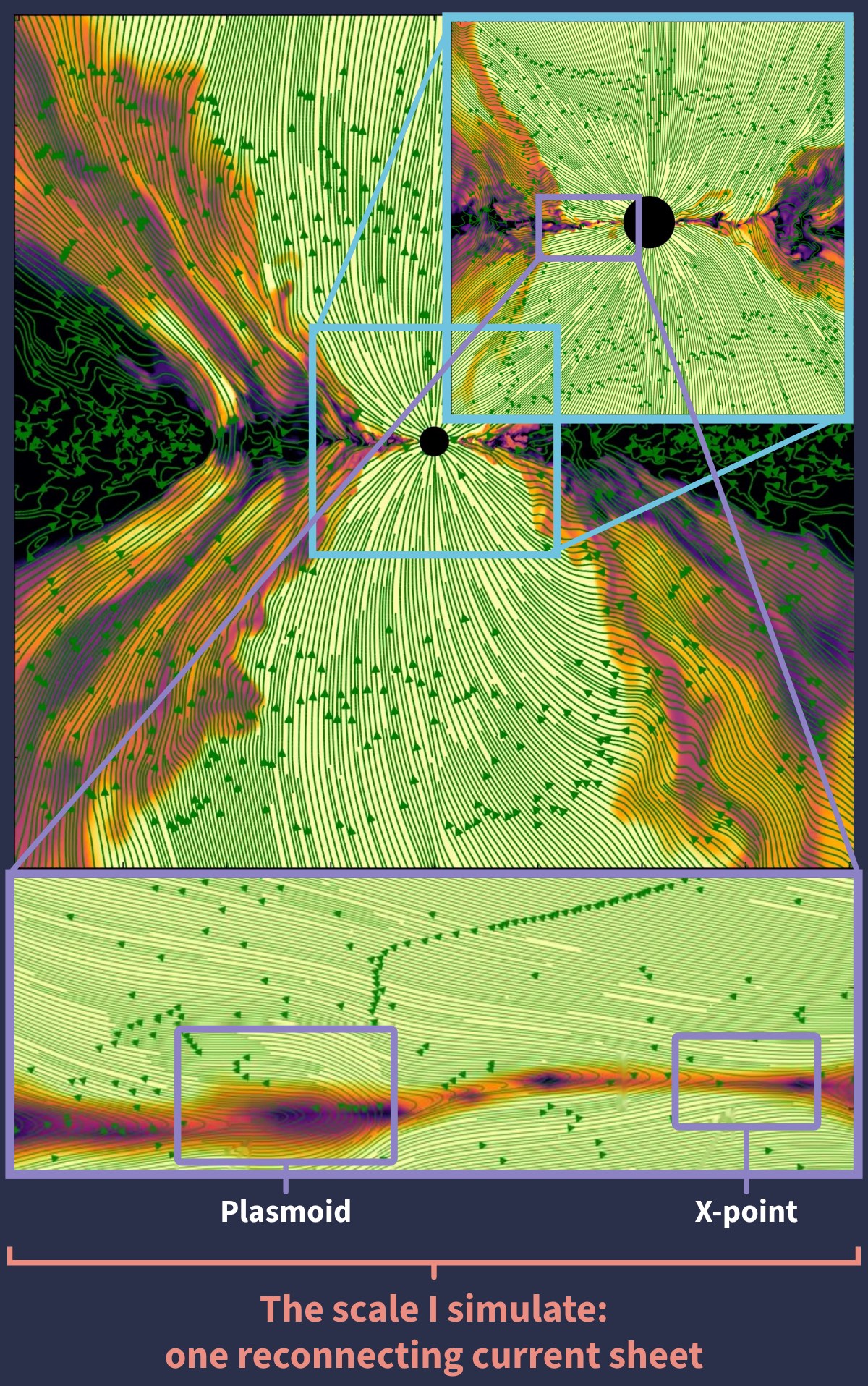
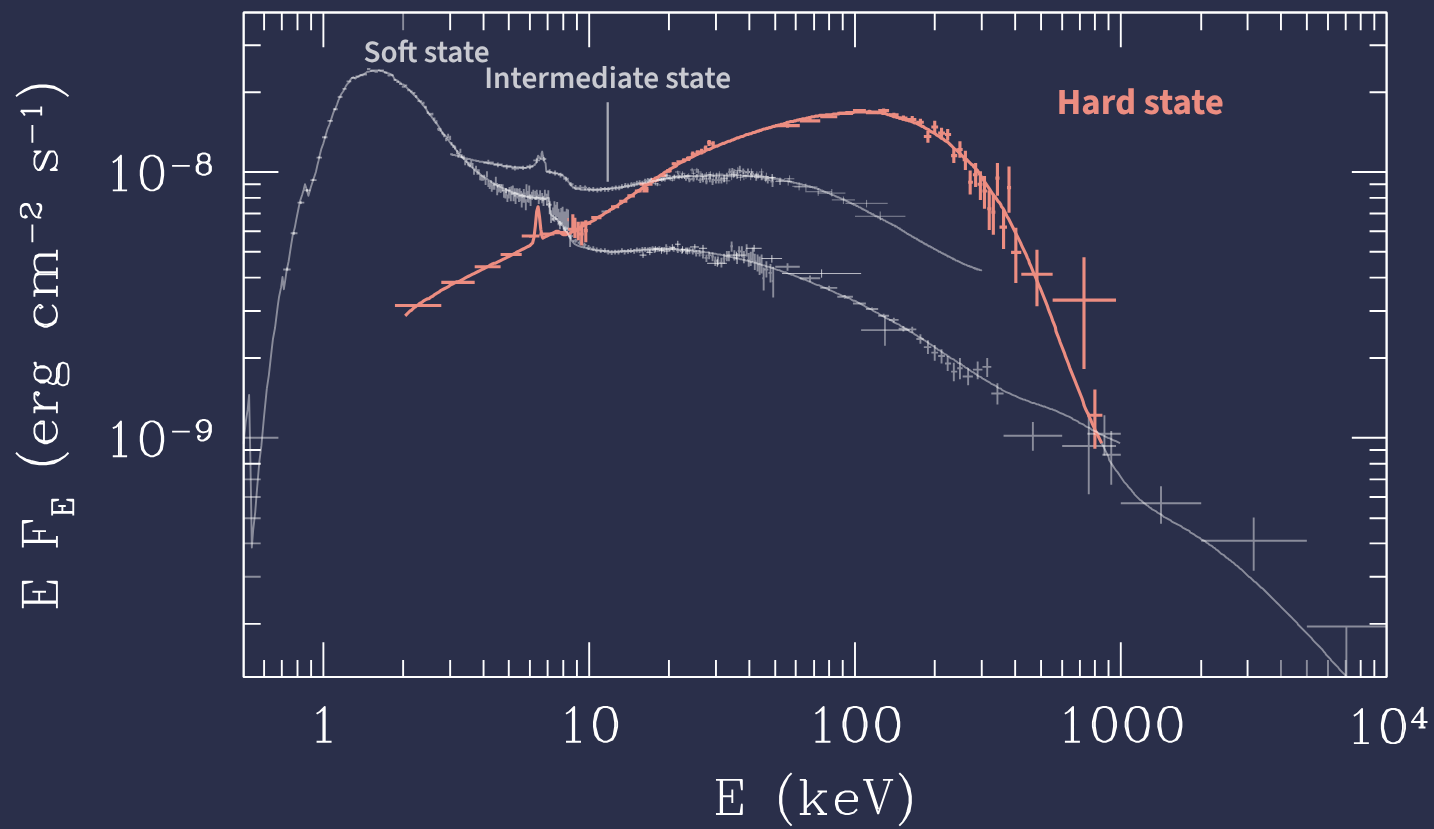
Surrounding the event horizon of certain accreting black holes, such as those living in luminous active galactic nuclei (AGN) or X-ray binaries (XRBs), lies the powerhouse of X-ray emission: a region of relativistically hot plasma of moderate optical depth called a corona. The corona shines in hard X-rays, as in the hard state of Cyg X-1 (below), peaking near 100 keV; the emission is believed to be produced by the Comptonization of soft seed photons by hot electrons (\(k_{\rm B}T_{\rm e} \sim 100\,{\rm keV}\)). Energetic X-ray coronal emission may be driven by magnetic reconnection, where oppositely directed field lines break and rejoin in a thin layer, transferring stored magnetic energy to the surrounding plasma as heat and particle acceleration; such large-scale reconnection layers do form within the putative corona in global simulations of accreting black holes (below; G. Musoke et al., in prep.).
The particles accelerated in the reconnection layer are theorized to energize the surrounding seed photons through inverse Compton (IC) scattering. Recent studies have shown that upscattering may also occur on bulk motions, rather than on individual electrons, such as from plasmoids (magnetic islands) in reconnection layers or turbulent motions. This process is well captured in radiative particle-in-cell (PIC) simulations, which follow individual particles; however, the interaction between heating and cooling is typically not modelled in magnetohydrodynamics (MHD).
Reconnection in high-energy sources commonly occurs in the relativistic regime, where the upstream magnetic energy density far exceeds the plasma rest-mass energy density \((\sigma_0 \equiv B_0^2/4\pi\rho_0 c^2 \gg 1)\), driving efficient non-thermal particle acceleration. It is frequently accompanied by rapid radiative cooling that competes against the acceleration. A prominent candidate for relativistic radiative reconnection is the black hole corona, the hot plasma of moderate optical depth near the event horizon of luminous accreting black holes, where reconnection has been proposed to energize the plasma and power the hard X-ray emission. These hard X-rays, seen for example in the hard state of Cyg X-1 (below), are believed to come from Comptonization of soft seed photons by mildly relativistic hot electrons \((k_{\rm B}T_{\rm e} \sim 100\,{\rm keV})\) as well as by the bulk plasma flow. Large-scale reconnecting current sheets form within the putative coronal region in global GRMHD simulations, as shown below (G. Musoke et al., in prep.).
How do we model it?
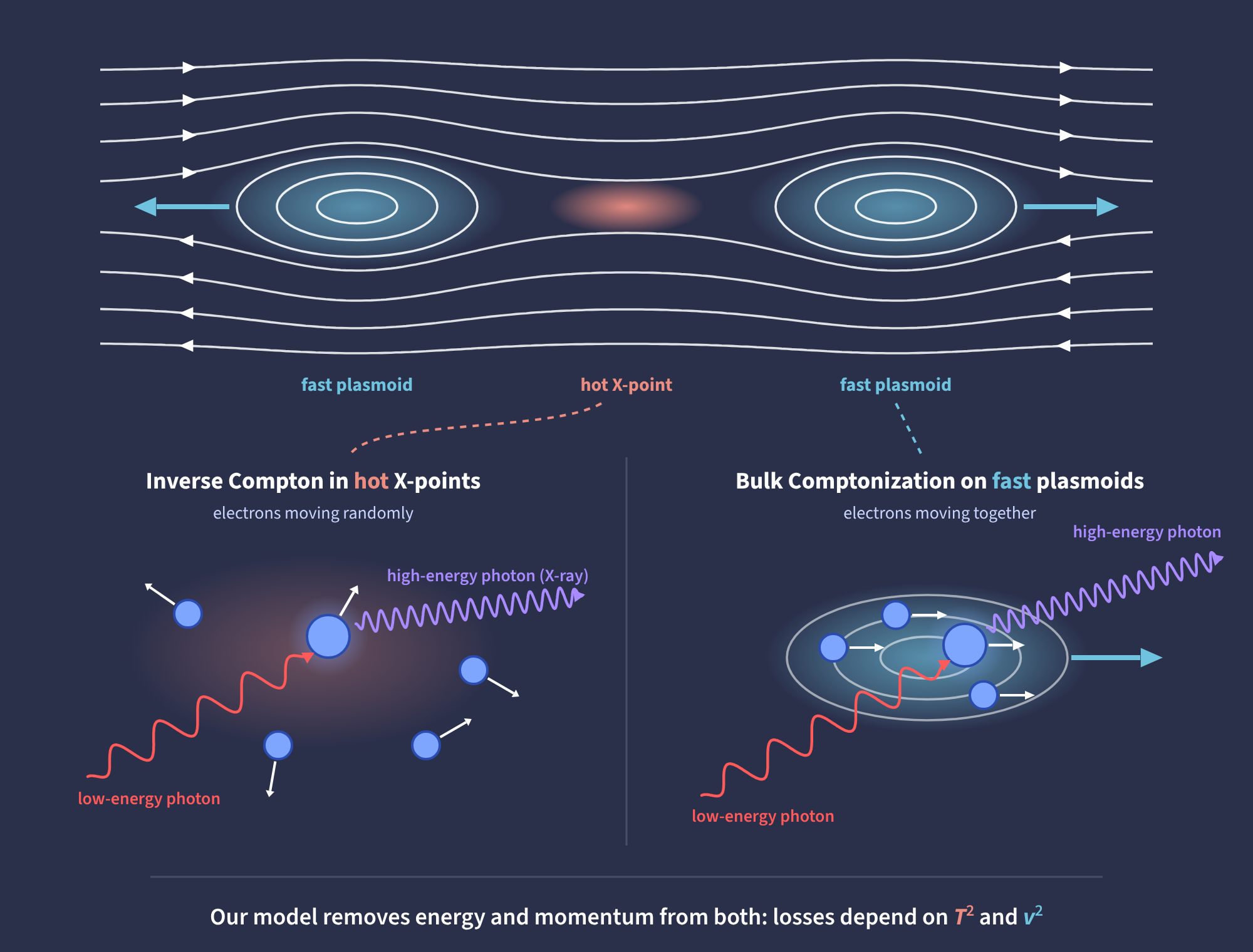
To include these effects in global general-relativistic MHD (GRMHD) simulations of accretion, we add a radiative cooling model to a relativistic resistive MHD (RRMHD) fluid, together with a prescription for the fast kinetic reconnection rate, which GRMHD lacks. We benchmark this model against ground-truth PIC simulations of a local reconnection layer in identical conditions. As a first step (Paper I), we model IC cooling of a pair (electron–positron) plasma in the optically thin regime (where photons escape freely), in a uniform, isotropic background radiation field. Our model captures both IC scattering off the random motions of hot electrons in the X-points and the bulk Comptonization off the coherent fast outflow, as illustrated below.
Global GRMHD simulations lack essential microphysics of collisionless reconnection, namely a fast reconnection rate and physically informed models for the plasma–radiation interaction. Kinetic PIC simulations capture that microphysics but are limited to a local reconnection layer. We therefore add a radiative cooling model to RRMHD and benchmark it against ground-truth PIC simulations of a local reconnection layer in identical conditions. As a first step (Paper I), we model inverse Compton (IC) cooling of a pair plasma in the optically thin regime, in a uniform, isotropic background radiation field \(u_{\rm rad}\).
A drag force on every particle
In PIC, each electron and positron is pushed around by the Lorentz force from the electromagnetic fields; as it moves through a bath of soft photons, it loses energy to IC scattering, which we apply as a radiative drag force opposing its motion. The average reconnection electric field accelerates the particles until the drag balances it, at a characteristic Lorentz factor \(\gamma_{\rm rad}\) where all the energy from reconnection goes into radiation. Expressing the drag force in terms of \(\gamma_{\rm rad}\) lets it control the strength of the cooling (i.e., a smaller \(\gamma_{\rm rad}\) means stronger cooling).

Particles travel through a photon bath of energy density \(u_{\rm rad}\), and IC losses enter as a radiative drag force subtracted from the Lorentz force. Balancing the drag against the reconnection electric field \(E_{\rm rec} = \beta_{\rm rec} B_0\) defines the characteristic Lorentz factor \(\gamma_{\rm rad}\) at which all the energy from reconnection goes into radiation. Reparametrizing the drag force in terms of \(\gamma_{\rm rad}\) lets it control the strength of the cooling (i.e., a smaller \(\gamma_{\rm rad}\) means stronger cooling). Together with the layer half-thickness \(\Delta\) (the hot Larmor radius), \(\gamma_{\rm rad}\) fully sets the radiative regime.
An energy and momentum sink
In a fluid model, rather than following individual particles we average over their collective motion, solving the RRMHD equations, which couple the conservation of mass, energy, and momentum to Maxwell’s equations. Radiative losses then enter as a sink term subtracted from the energy and momentum equations, derived by averaging the IC drag over the electron and photon distributions, so that the random motions of the electrons become a temperature and their coherent motion a bulk velocity. The losses then scale with the temperature squared (IC scattering) and the bulk speed squared (bulk Comptonization).

In a fluid model, radiative losses become a sink \(S^\mu\) in the energy and momentum equations. Following Golan & Levinson (2015), we average over the boosted electron (Maxwell–Jüttner) and photon distributions, so that the individual particle motions translate into a dimensionless temperature \(\Theta = k_{\rm B}T/m_{\rm e}c^2\) and a bulk four-velocity \(\Gamma\beta_\Gamma\). The \(\Theta^2\) terms capture IC scattering in the hot X-points, and the \(\Gamma^2\beta_\Gamma^2\) term captures bulk Comptonization on the fast plasmoids.
Fast reconnection in the fluid: charge-starved resistivity
A fluid model needs resistivity to let magnetic field lines break and rejoin, and the shape of the resistivity sets how fast reconnection proceeds. In relativistic reconnection, the plasma around the X-points becomes charge-starved: the current density nears the maximum that the available charges can carry (Moran et al. 2025). In RRMHD, we capture this with a localized, effective resistivity that reproduces the fast kinetic reconnection rate (Ripperda et al. 2026). This model also matches the reconnection electric field from PIC, so the balance that defines \(\gamma_{\rm rad}\) holds in the fluid formalism as well, and the RRMHD cooling can be controlled with the same \(\gamma_{\rm rad}\) as PIC.
In relativistic reconnection, the diffusion regions around the X-points approach charge starvation: the current density nears the maximum the available charges can carry, \(\lvert\mathbf{J}\rvert \approx 2n_{\rm e}ec\) (Moran et al. 2025). In RRMHD, we capture this with a localized, effective resistivity \(\eta_{\rm eff} = \lvert\mathbf{E}^{\ast}\rvert/\lvert\mathbf{J}\rvert\), which introduces an effective skin depth \(\lambda_{\rm e}\) and recovers the kinetic non-ideal electric field \(\mathbf{E}^{\ast}\), and hence the fast reconnection rate (Ripperda et al. 2026). This skin depth sets the layer half-thickness, \(\Delta \sim \sqrt{\sigma_0}\,\lambda_{\rm e}\), so the fluid and kinetic layers share both \(\Delta\) and the reconnection electric field \(E_{\rm rec} = \beta_{\rm rec} B_0\); the same force balance then defines the cooling strength in both models, giving a one-to-one mapping \(\gamma_{\rm rad}^2 \to 12\Theta_{\rm rad}^2\) for a thermal distribution.
We define four cooling regimes by comparing the cooling time \(t_{\rm IC}\), set by \(\gamma_{\rm rad}\), with two crossing times: that of a diffusion region, \(t_{\rm D}\), and that of the whole layer by the outflow, \(t_{\rm adv}\) (Sironi & Beloborodov 2020).
| Cooling regime | Cooling time | Condition | Our runs | Where it happens |
|---|---|---|---|---|
| Strong | \(t_{\rm IC} \lesssim t_{\rm D}\) | \(\gamma_{\rm rad}^2 \lesssim \sigma_0^2\) | \(\gamma_{\rm rad} = 10\)–15 | Pulsar and M87* current sheets |
| Moderate | \(t_{\rm D} \ll t_{\rm IC} \ll t_{\rm adv}\) | \(\sigma_0^2 \ll \gamma_{\rm rad}^2 \ll \beta_{\rm rec}L\sigma_0/\Delta\) | 17–32 | Black hole coronae, GRB jets |
| Weak | \(t_{\rm IC} \gg t_{\rm adv}\) | \(\gamma_{\rm rad}^2 \gg \beta_{\rm rec}L\sigma_0/\Delta\) | 60 | Quasar jets |
| None | \(t_{\rm IC} \to \infty\) | \(\gamma_{\rm rad} \to \infty\) | \(\infty\) | — |
\(t_{\rm IC}\): cooling time; \(t_{\rm D}\): time to cross a diffusion region; \(t_{\rm adv}\): time for the outflow to cross the layer (\(L\) = half-length, \(\Delta\) = half-thickness).
Does it work?
Set-up2D Harris current sheet · pair plasma · magnetization \(\sigma_0 = 15\) · guide field \(0.5B_0\) · RRMHD: BHAC · PIC: TRISTAN-MP v2 · ~\(30{,}000^2\) cells
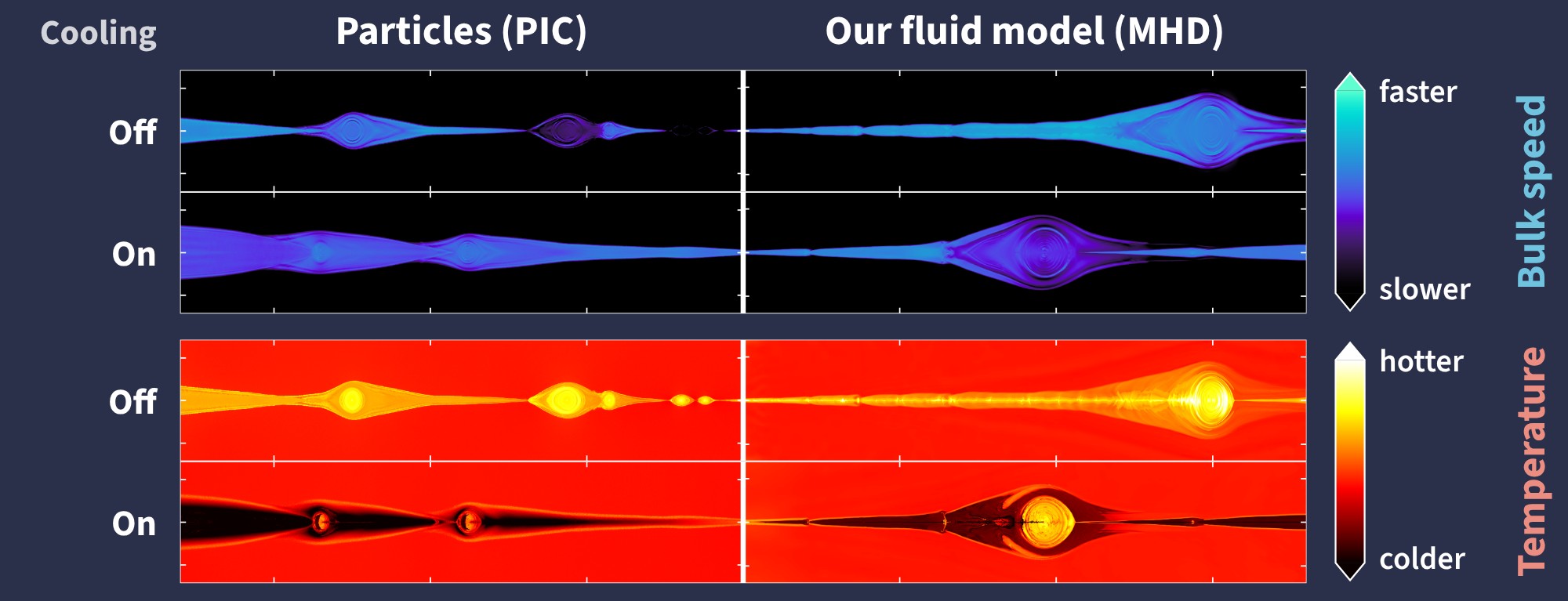
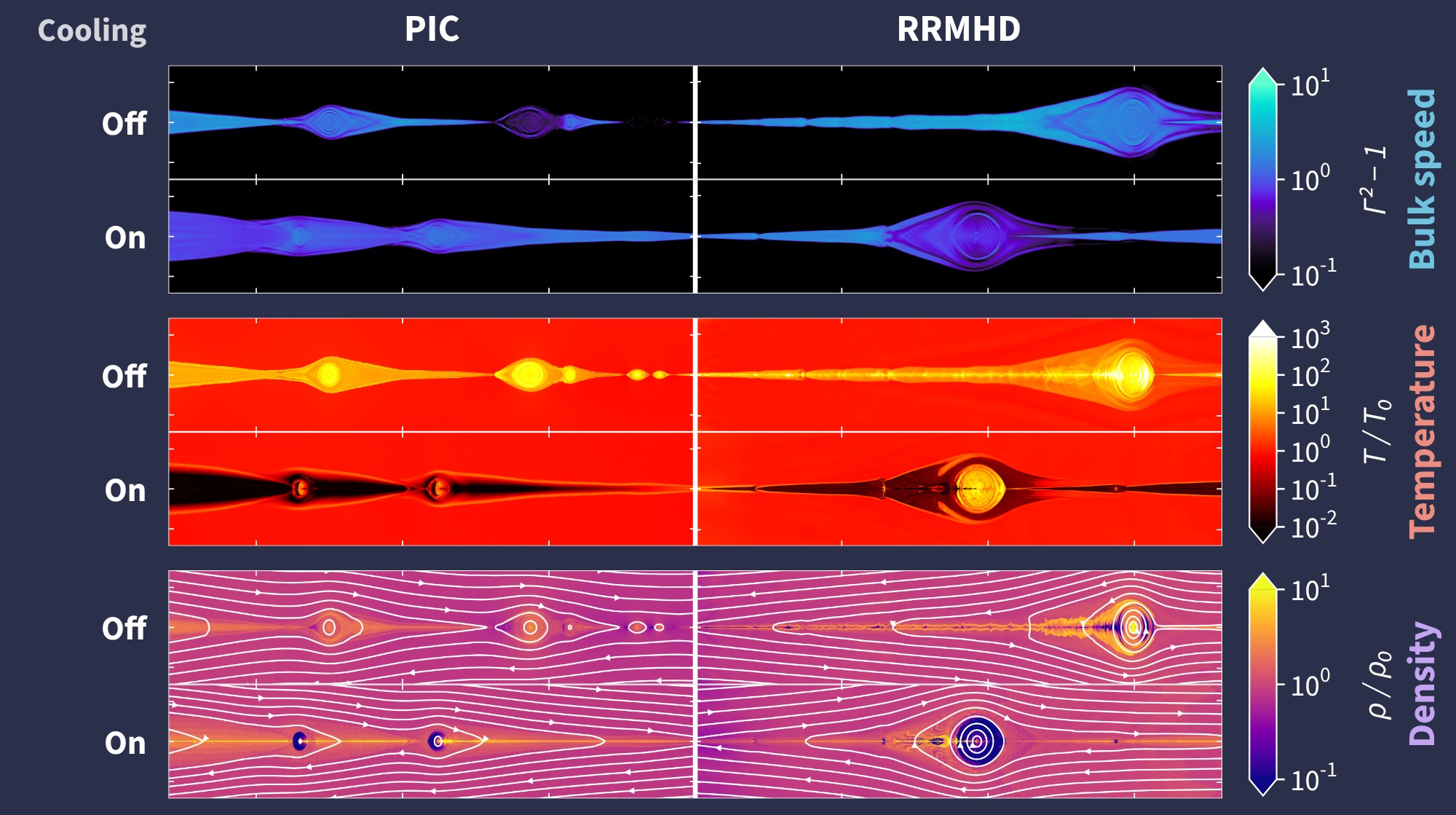
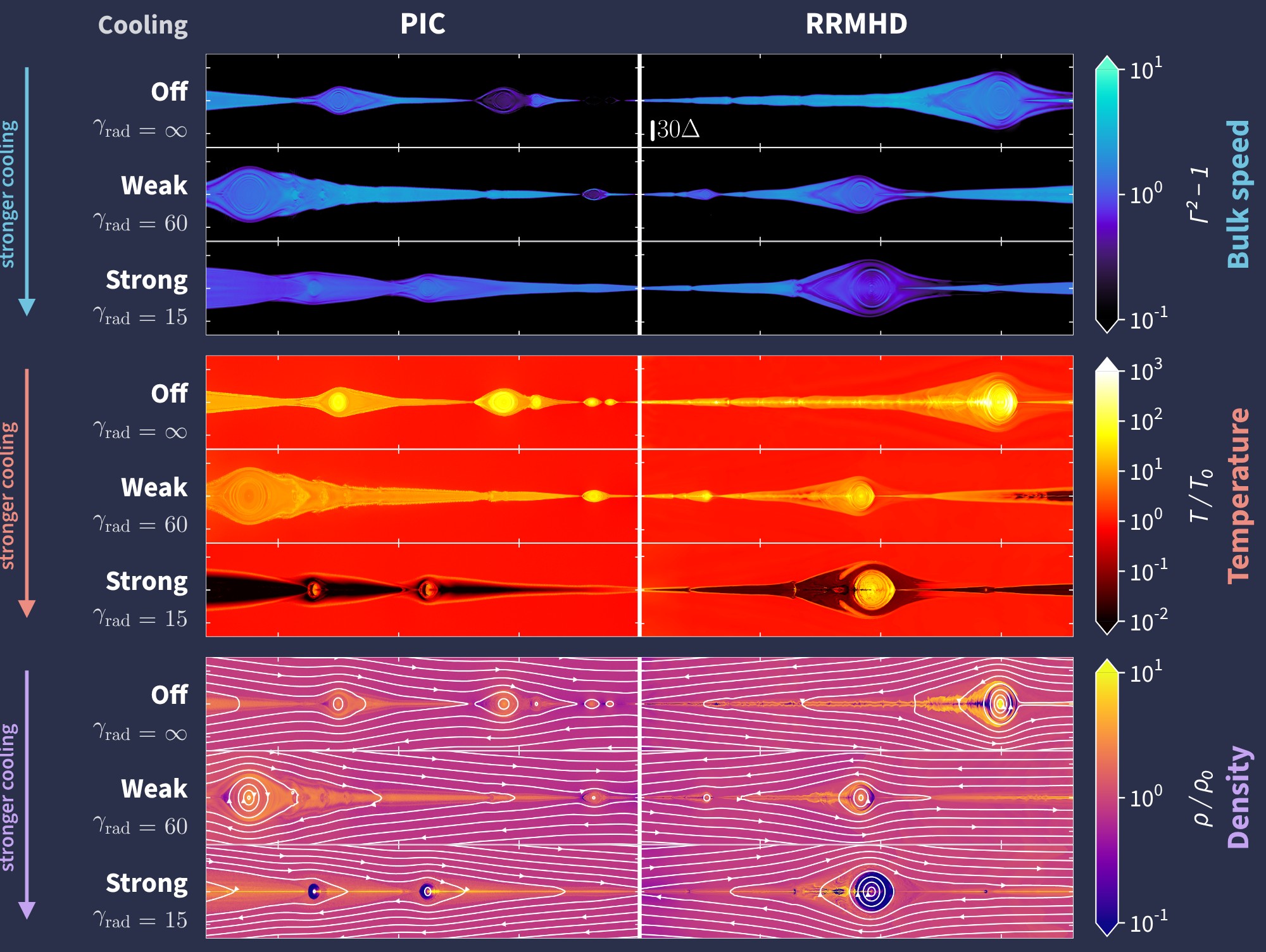
We compare RRMHD with PIC across a range of cooling strengths, from no cooling to strong cooling, with black hole coronae expected to lie at the moderate case. Regardless of cooling strength, our RRMHD model reproduces the overall morphology of the reconnection layer and the typical bulk speed, temperature, and density in the sheet (above) when benchmarked against PIC simulations.
For all cooling regimes, our RRMHD model reproduces the overall morphology of the reconnection layer and the typical magnitudes of the bulk speed, temperature, and density in the sheet. Our model also recovers the kinetic reconnection rate and the Alfvénic outflow; cooling has a negligible effect on both.
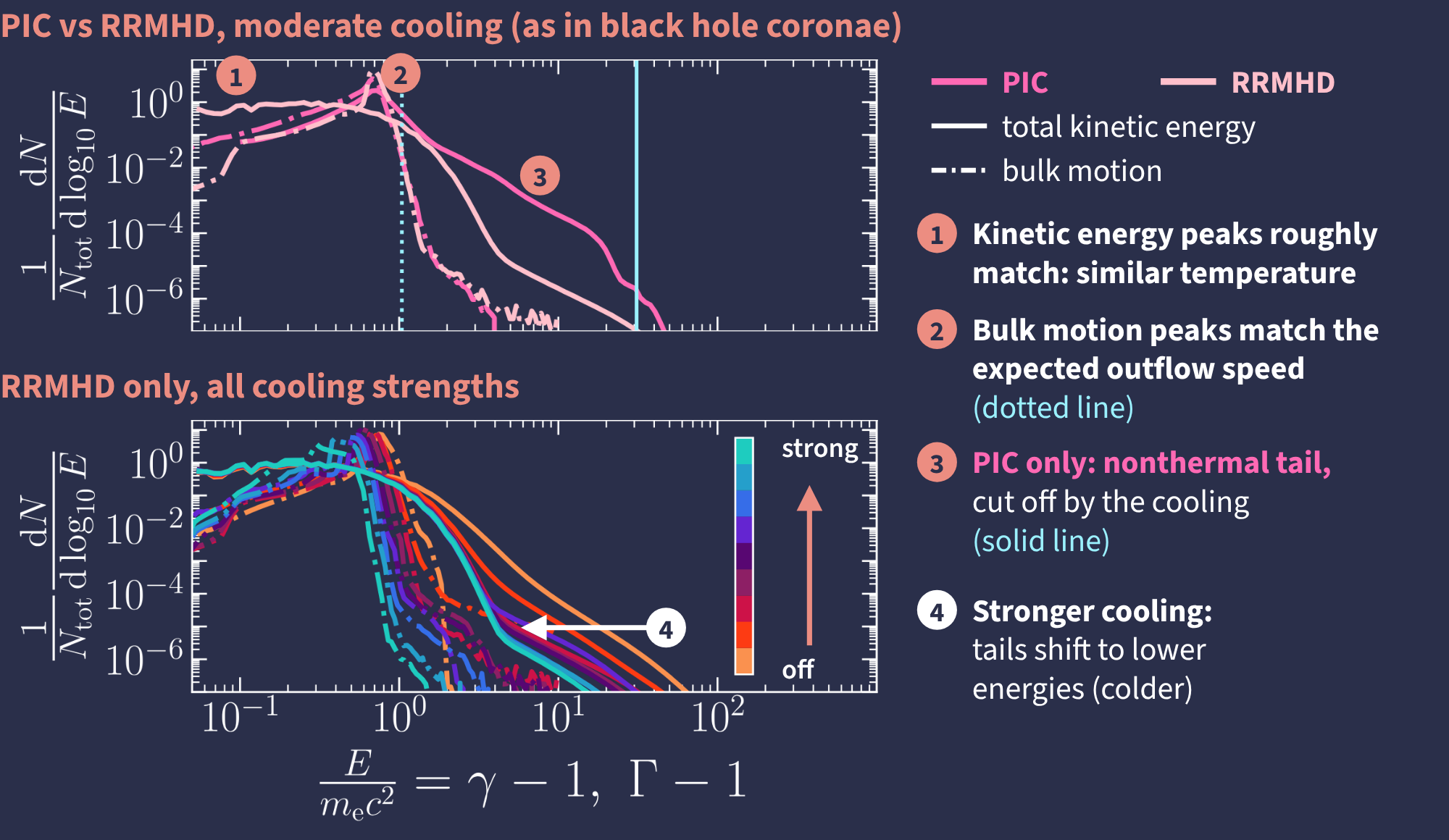
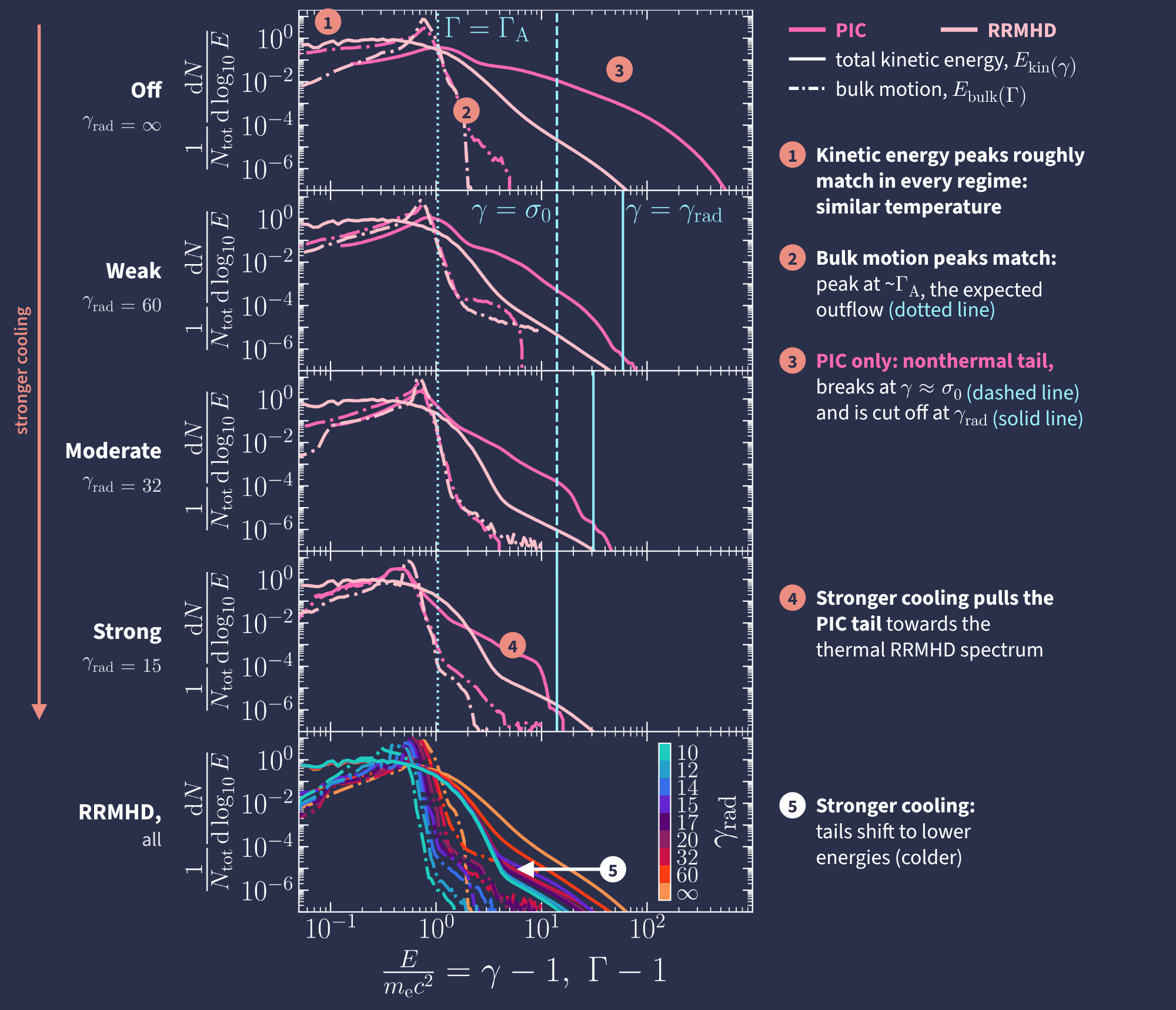
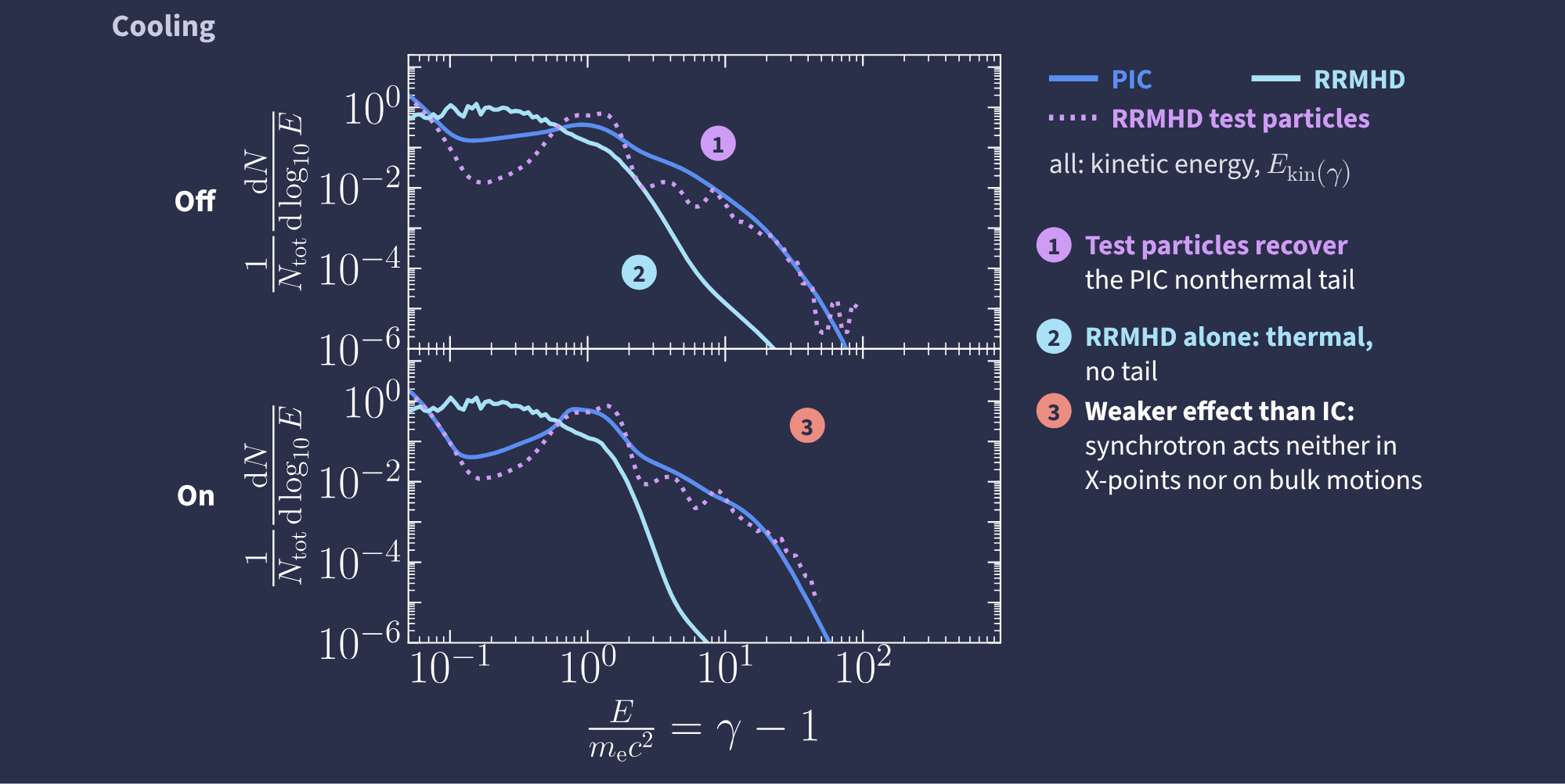
The most quantitative test of our radiative model is the distribution of the total kinetic energy and the bulk motion energy in the reconnection layer. The distributions peak at roughly the same temperature (dictated by the kinetic energy) and outflow speed (dictated by the bulk motion energy) in both models, describing the motion that Compton-scatters photons. RRMHD by itself does not capture the non-thermal tail of the kinetic spectrum, though this gap shrinks with stronger cooling, which drives the plasma closer to a thermal state.
The most quantitative comparison is in the energy spectra of the reconnection layer: we compare both the total kinetic energy spectrum (found in RRMHD via a per-cell drifting Maxwellian) and the bulk motion energy spectrum. The spectra show good agreement in temperature and outflow; however, RRMHD by itself does not capture the kinetic non-thermal tail (see below).
In Paper II, led by Maëlle Magnan, we extend our model to synchrotron cooling, the radiation from electrons gyrating relativistically around magnetic field lines. As for IC, balancing the reconnection electric field against synchrotron losses defines a characteristic Lorentz factor \(\gamma_{\rm sync}\) that sets the cooling strength. The addition of test particles, which are pushed by the RRMHD fields without feeding back on them, is able to capture the kinetic non-thermal tail.
In Paper II, led by Maëlle Magnan, we extend our model to synchrotron cooling. Balancing the reconnection electric field against synchrotron losses defines \(\gamma_{\rm sync}\), analogous to \(\gamma_{\rm rad}\). The addition of test particles pushed by the RRMHD fields is able to capture the kinetic non-thermal tail.
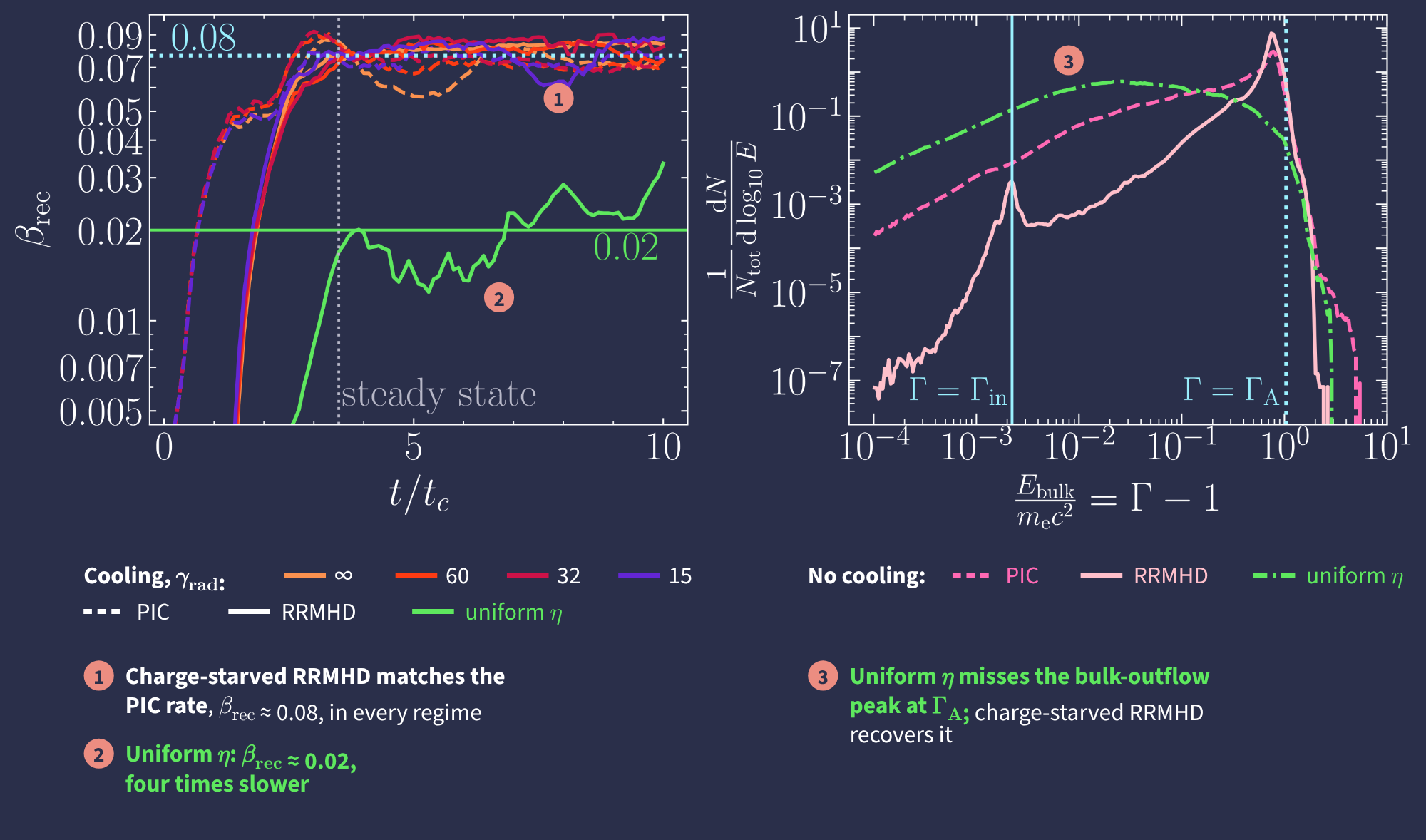
With the charge-starved resistivity, we capture the fast kinetic reconnection rate (\(\langle\beta_{\rm rec}\rangle \approx 0.08\), compared with 0.02 with uniform resistivity), and the peak in the bulk outflow spectrum. Although the bulk motions still reach the Alfvénic \(\Gamma_{\rm A}\) with uniform resistivity, the peak there is less defined and orders of magnitude less energetic. The reconnection rate sets the aspect ratio of the diffusion regions, and thus the field-line tension that drives the outflow. Matching the kinetic rate is therefore essential to capture the bulk motions, and hence bulk Comptonization, which neither a uniform resistivity nor ideal GRMHD with numerical resistivity can do.
What’s next?
With the model validated against kinetic theory, the next step is to apply it in global resistive GRMHD simulations of black hole accretion, where reconnection sites form self-consistently. I will also extend the model to include more physics: (1) two-temperature plasma, pairing our cooling with heating of electrons and ions through the resistivity (Ohmic heating); (2) M1 radiation transport, replacing the uniform, isotropic photon field with one that evolves in time and space and exchanges energy and momentum with the plasma, as needed in more optically thick regimes; and (3) pair production and annihilation.
Now that the model has been validated against kinetic theory, it can be applied to global resistive GRMHD simulations of black hole accretion, where reconnection sites form self-consistently. I will also extend the model to include more physics: (1) two-temperature RRMHD, pairing our cooling with Ohmic heating of electrons and ions; (2) M1 radiation transport, replacing the uniform, isotropic \(u_{\rm rad}\) with a photon field that evolves in time and space and exchanges energy and momentum with the plasma, as needed in more optically thick regimes; and (3) pair production and annihilation.